
Connectivity blackouts, access bans and source security — the invisible costs of producing verified information in a crisis zone.
Access obstacles
Physical access to Gaza has been systematically restricted since 2023. The great majority of international observers and journalists cannot enter the region; those who do are forced to work under short and supervised conditions.
This directly affects data verification: without primary-source access, only remote-verification methods can be employed. Internet blackouts, meanwhile, continually disrupt the real-time flow of information.
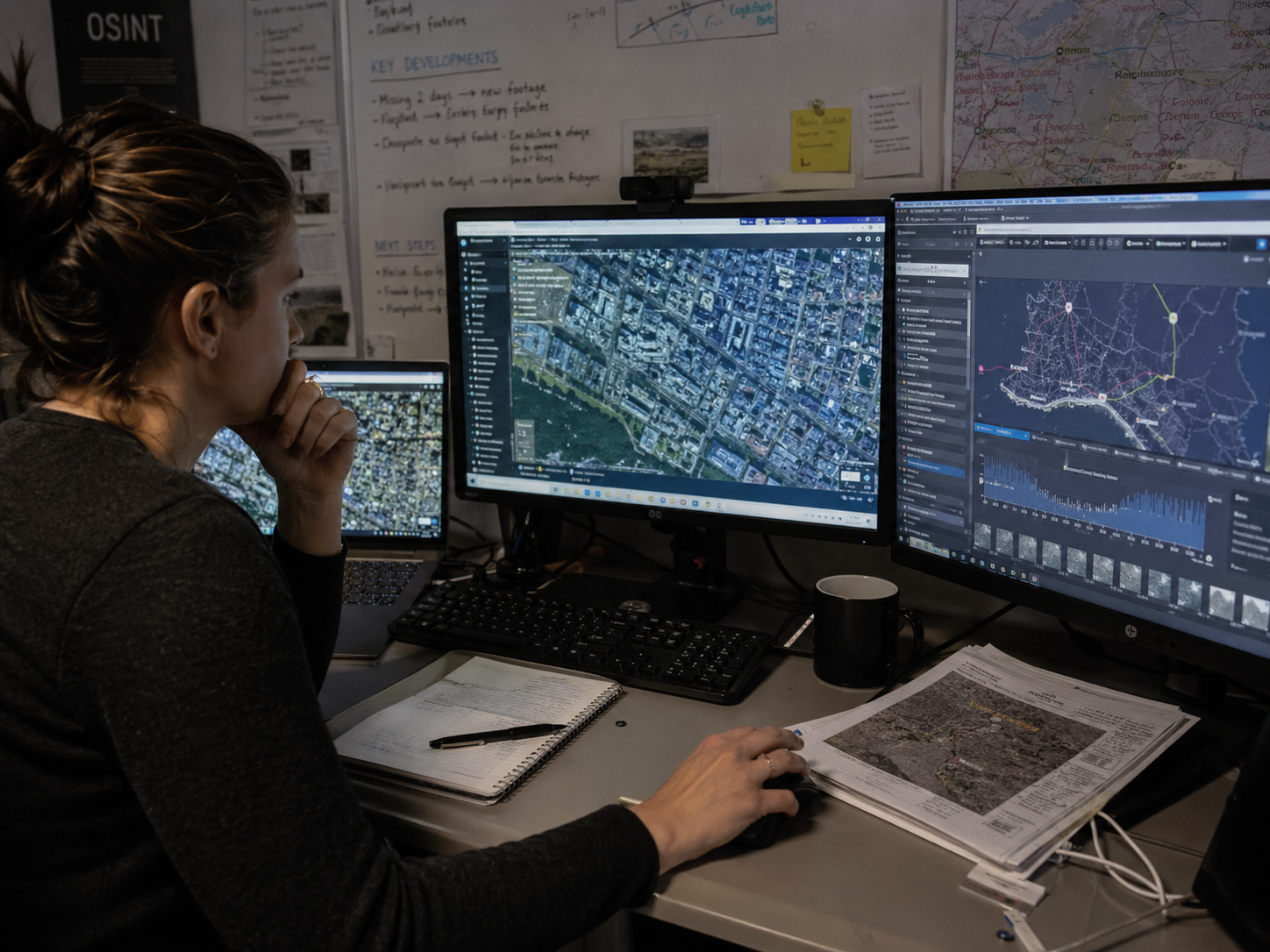
For the researcher who cannot reach the field, the screen is the only window. You must constantly question how reliable that window is.
Source security
Local sources working in the region prefer to remain anonymous so that their identities are not exposed. This slows the verification process: a single person's statement is not enough on its own; at least two independent sources and, where possible, open-source verification are required.
To ensure source security, end-to-end encrypted communication, short-term storage and de-identification protocols were put in place. Building trust with local NGOs in the region, meanwhile, took months.
Open-source tools
Among the indispensable tools of remote verification are satellite-image analysis, shadow- and environment-based geolocation, and archiving tools. Planet Labs and Sentinel Hub imagery enabled us to document the temporal course of the destruction.
That said, knowing the limits of these tools is as important as knowing how to use them. A satellite image shows that a building has been destroyed; not by whom or under what conditions. Context always comes from human sources.